
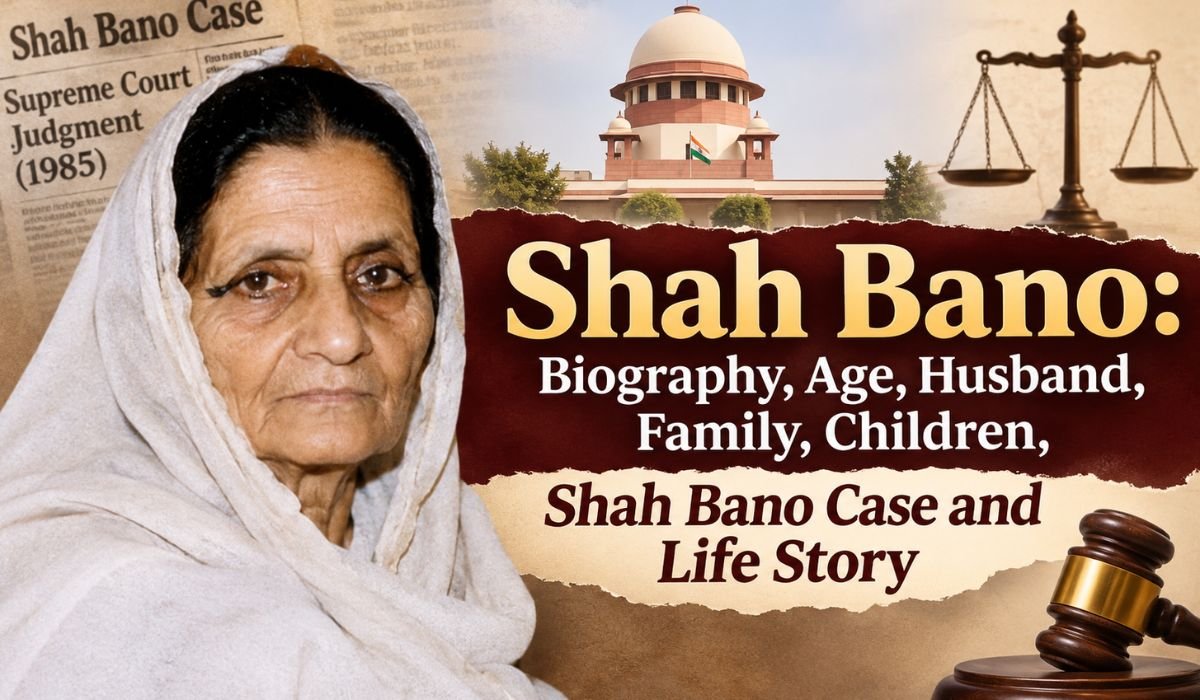
Shah Bano Begum was an Indian woman who gained prominence through a significant legal fight for maintenance after her divorce. The case, officially named Mohd. Ahmed Khan v. Shah Bano Begum, is considered to be one of the most widely debated decisions ever made by the Indian courts. The Supreme Court of India rendered a historic ruling in 1985 recognizing the right of a divorced Muslim woman to claim maintenance from her husband pursuant to Section 125 of the Code of Criminal Procedure (CrPC).
In 1916, Shah Bano married Mohammed Ahmed Khan, with whom she had five children. Following their separation, Shah Bano filed for monetary assistance through the courts. This was the beginning of a long legal battle that would address many issues concerning women’s rights; Muslim personal law; maintenance after divorce; and a potential Uniform Civil Code in India. Today, Shah Bano is recognized as a key figure in the history of law and society in India.
Shah Bano Biography
The first time most people had heard of Shah Bano Begum, she was a simple housewife from India, who became a household name when she sued her ex-husband for alimony. There isn’t much known about Shah Bano Begum’s childhood, education, or even her early family history. However, her lawsuit highlighted the economic hardships many divorced women face.
Here is a quick overview of Shah Bano’s personal life and background.
| Details | Information |
| Full Name | Shah Bano Begum |
| Popular Name | Shah Bano |
| Birth Year | 1916 |
| Age at Death | Approximately 76 Years |
| Birthplace | Not clearly documented |
| Nationality | Indian |
| Religion | Islam |
| Profession | Known for her legal case |
| Husband | Mohammed Ahmed Khan |
| Marriage Year | 1932 |
| Children | 5 |
| Sons | 3 |
| Daughters | 2 |
| Divorce Year | 1978 |
| Famous For | Shah Bano Case (1985) |
| Court | Supreme Court of India |
| Death Year | 1992 |
| Death Cause | Brain Haemorrhage |
Shah Bano Age and Early Life
Shah Bano was born in 1916. There is very little known about her birthdate, where she grew up, who her parents were and what kind of education she received.
She was a homemaker for most of her adult years while raising five children with her husband. Her private life received little public notice until after the couple’s relationship ended in divorce.
At about the age of sixty-two years old, Shah Bano filed a lawsuit against her husband in April 1978 for support. As a result of this action, the U.S. Supreme Court issued a landmark ruling in 1985.
She passed away in 1992 at approximately 76 years of age.
Shah Bano Husband: Who Was Mohammed Ahmed Khan?
Shah Bano’s husband was Mohammed Ahmed Khan, who she wedded in 1932. Mr. Khan was a prominent and wealthy lawyer living in Indore, Madhya Pradesh.
For many years, the couple was married and had five kids. History records that Mohammed Ahmed Khan married a second wife, Halima Begum, in 1946.
The couple separated in 1975 when Shah Bano left the matrimonial home. After the separation, her husband provided financial support for a period of time. However, this changed when he ceased providing the monthly payments.
In November 1978, Mohammed Ahmed Khan made a final divorce from Shah Bano using the irrevocable talaq process. He stated that he had met all of his monetary requirements as outlined in Muslim personal law through payment of mahr and providing maintenance for the duration of the iddat.
However, Shah Bano persisted with her lawsuit to receive monetary aid past the iddat period.
Shah Bano Family and Children
Shah Bano and her husband Mohammed Ahmed Khan were married for a number of years, during which time they raised five children together. The couple’s children consisted of three boys and two girls.
While there was some degree of documentation on her children’s participation in the maintenance dispute, there are few credible, publically available sources that provide specific details about their names and career paths.
| Family Details | Information |
| Husband | Mohammed Ahmed Khan |
| Total Children | 5 |
| Sons | 3 |
| Daughters | 2 |
| Second Wife of Husband | Halima Begum |
| Husband’s Profession | Advocate |
The separation of her parents caused her to have some financial issues, which in turn became a big part of the law suit.
Shah Bano Divorce and Maintenance Dispute
The defining moment of Shah Bano’s existence occurred in 1975 when her husband took her out of their joint home.
In April 1978, the petitioner submitted a request for monthly support (₹500) from her husband through Section 125 of the Code of Criminal Procedure, 1973.
In the course of the legal action, Mohammed Ahmed Khan divorced her in November of 1978. He said that he was not required to continue paying for her support following the divorce as he had previously provided the amount necessary according to Muslim personal law.
However, Shah Bano continued to pursue her claim through the courts.
In 1979, the lower court had directed her spouse to provide Rs 25/month. Subsequently, the Madhya Pradesh High Court enhanced the maintenance to Rs 179.20/month during 1980.
The court was asked to review the decision of the husband by bringing the matter to the top court in India.
Shah Bano Case: The Historic Supreme Court Judgment of 1985
The judgment of Mohd. Ahmed Khan vs. Shah Bano Begum has been a key decision in the development of India’s judicial system.
The five-judge panel of the Supreme Court of India rendered a decision in favor of Shah Bano on April 23, 1985.
The Court decided she had the right to make a request for maintenance pursuant to Section 125 of the Criminal Procedure Code (CrPC), stating that Section 125 of the CrPC applies to all citizens regardless of their religious affiliation.
The five judges who heard the case were:
- Chief Justice Y. V. Chandrachud
- Justice Ranganath Misra
- Justice D. A. Desai
- Justice O. Chinnappa Reddy
- Justice E. S. Venkataramiah
In addition, the Supreme Court has denied her spouse’s petition and upheld the High Court’s decision to provide a monthly payment of INR 179.20.
The Supreme Court clarified that a divorced Muslim woman, who was unable to support herself, may seek maintenance pursuant to Section 125, provided she meets the legal criteria. Additionally, the Court addressed how secular law interacts with personal religious laws.
Shah Bano Case and Section 125 CrPC
Under Section 125 of the Code of Criminal Procedure, 1973, individuals who were unable to support themselves had access to a law-based solution to their problem.
A wife, (even a divorced woman who has not remarried) may seek financial support from her ex-husband provided that all relevant legal requirements are met.
The Supreme Court has stated that Section 125 is a secular provision, and can be used by anyone of any faith.
Because it recognized that post-divorce financial assistance is both a form of legal protection and a social welfare issue, this is an essential component of the court’s decision.
Shah Bano Case and Uniform Civil Code
The judgment in the Shah Bano case has brought the Uniform Civil Code (UCC) to the forefront of national debate.
Article 44 of the Indian Constitution provides that the state shall strive to provide a Uniform Civil Code (UCC) for all Indian citizens.
The matter of the case raised concerns regarding the correlation of religious based personal law systems and the common protective laws that exist.
The conference was a platform for discussing the equality between men and women as it relates to their finances and legal rights after divorce.
Shah Bano Case Controversy and 1986 Act
The 1985 ruling was received in various ways throughout the United States. Many Muslim religious groups and leaders were opposed to this ruling because they believed that it infringed upon their rights to follow their own religious laws regarding family matters.
On the other hand, many supporters of women’s rights and activists were happy with the decision since they thought that divorced women should be protected financially.
In response to the public outcry, the government under Prime Minister Rajiv Gandhi enacted the Muslim Women (Protection of Rights on Divorce) Act, 1986.
The law was created to address the right to a reasonable and equitable arrangement for divorced Muslim women, and also included a provision for an adequate amount of support during the iddat period.
The law also became an important issue in the legal debate concerning the initial decision.
Danial Latifi Case and Its Connection to Shah Bano
In 2001, the Supreme Court evaluated whether the Muslim Women (Protection of Rights on Divorce) Act, 1986 was valid constitutionally, in Danial Latifi v. Union of India.
The court has upheld the act and interpreted it so as to protect the economic rights of divorced muslim women.
The ruling also stated that a husband must provide for his divorced wife during the iddat period, however, that provision should be made to allow her to meet her ongoing financial requirements after the iddat period has ended.
The court’s decision was a major step forward for the development of law since Shah Bano had filed her suit for support.
Shah Bano Case: Legal Importance and Legacy
The long-standing legal dispute surrounding Shah Bano has had a lasting effect on how women’s rights are discussed within India.
Its importance can be understood through several key points:
- It highlighted the maintenance rights of divorced Muslim women.
- It clarified the applicability of Section 125 CrPC irrespective of religion.
- It encouraged nationwide discussions about gender equality and personal laws.
- It brought renewed attention to Article 44 and the Uniform Civil Code.
- This decision also had an impact on future decisions of the courts regarding the issue of maintenance and financial security for women.
The court’s decision continues to serve as a valuable resource when discussing the interrelationship of religious law and protective measures provided by the state to individuals based on their religion.
Shah Bano Death and Last Years
Shah Bano died in 1992. According to some reports on Shah Bano’s life, she suffered from a brain hemorrhage prior to passing away.
She was about 76 years old when she passed away. While she would not have seen the subsequent legal battles related to her lawsuit, her legacy remained an integral component of India’s legal system.
Her situation remains a topic of discussion in law courses, women’s rights discussions, and discussions regarding post-divorce support.
Interesting Facts About Shah Bano
Here are some important facts about her life and historic legal case:
- Shah Bano was married to Mohammed Ahmed Khan in 1932.
- Her husband was a well-known advocate in Indore.
- She had five children, including three sons and two daughters.
- She approached the court in April 1978 for monthly maintenance.
- She initially requested ₹500 per month.
- Her maintenance was fixed at ₹179.20 per month by the Madhya Pradesh High Court.
- The Supreme Court delivered its historic judgment on 23 April 1985.
- The judgment was delivered by a five-judge bench.
- The case contributed to the passage of the 1986 Muslim Women Act.
Her ongoing court case continues to be relevant to conversations regarding women’s rights within India.
Explore more biographies, celebrity relationships, husband names, family details, and personal life stories on The Husband Names.
FAQs About Shah Bano
1. Who was Shah Bano?
Shah Bano Begum was a Muslim female in India that gained national attention due to her law suit against her former husband for financial support. In 1985, Shah Bano’s case led to a historic Supreme Court decision.
2. What was Shah Bano’s age?
Shah Bano lived from 1916 until she died in 1992, making her around 76 years old when she passed away.
3. Who was Shah Bano’s husband?
She was married to Mohammed Ahmed Khan, a lawyer who practiced law in Indore, Madhya Pradesh.
4. How many children did Shah Bano have?
She had five children from her marriage, including three sons and two daughters.
5. When did Shah Bano get divorced?
Mohammed Ahmed Khan divorced her in November 1978 through irrevocable talaq.
6. What was the Shah Bano Case?
This is an important court case where Shah Bano filed for support from her ex-husband under Section 125 of the CrPC. The Supreme Court ruled in her favor on April 23, 1985.
7. What was the Supreme Court judgment in the Shah Bano Case?
The Supreme Court ruled that a divorced Muslim woman, who was unable to support herself financially, can seek financial assistance (maintenance) pursuant to Section 125 of the Code of Criminal Procedure (CrPC), provided she meets all of the required legal conditions.
8. How much maintenance did Shah Bano demand?
The initial request by the woman for ₹500/month was later adjusted to ₹179.20/month by the Madhya Pradesh High Court.
9. What was the Muslim Women Act of 1986?
The Muslim Women (Protection of Rights on Divorce) Act, 1986 was passed in response to the controversy created by the Supreme Court decision in 1985. The act made provision for “reasonable and fair arrangements” as well as “maintenance” for divorced Muslim women.
10. When did Shah Bano die?
Shah Bano died in 1992. It is said she died from a brain hemorrhage.
11. Why is Shah Bano remembered in Indian history?
She will be remembered for the fact that she was involved in a major court case which has had a lasting impact on how people discuss their rights to child support, on what it means to be treated equally based on sex, on how Muslim personal law works, and on whether India should have a Uniform Civil Code.
12. What is the connection between Shah Bano and Danial Latifi?
Danial Latifi was the attorney representing Shah Bano in her lawsuit. He later contested the constitutionality of the Muslim Women (Protection of Rights on Divorce) Act, 1986, through another Supreme Court proceeding in 2001.
Conclusion
Shah Bano is a key figure in Indian legal and social history as a result of her persistence to receive monetary compensation from her husband following their divorce. Shah Bano’s case was ruled on by the Supreme Court in 1985 and has had long-lasting effects as it defined the way courts interpreted the maintenance provisions of Section 125 of the Criminal Procedure Code (CrPC).
The judgment also brought to light issues related to women’s financial security, personal religious laws, and the proposed Uniform Civil Code. Following this judgment, there were many other legal developments (such as the 1986 Act) that continued to debate the rights of divorced Muslim women, and ultimately culminated with the Danial Latifi judgment in 2001.
Even though it has been several decades since the Shah Bano case was decided, it continues to be a great illustration of how one person’s fight for their rights can turn into a nationwide discussion on justice, equality and social protection.
