
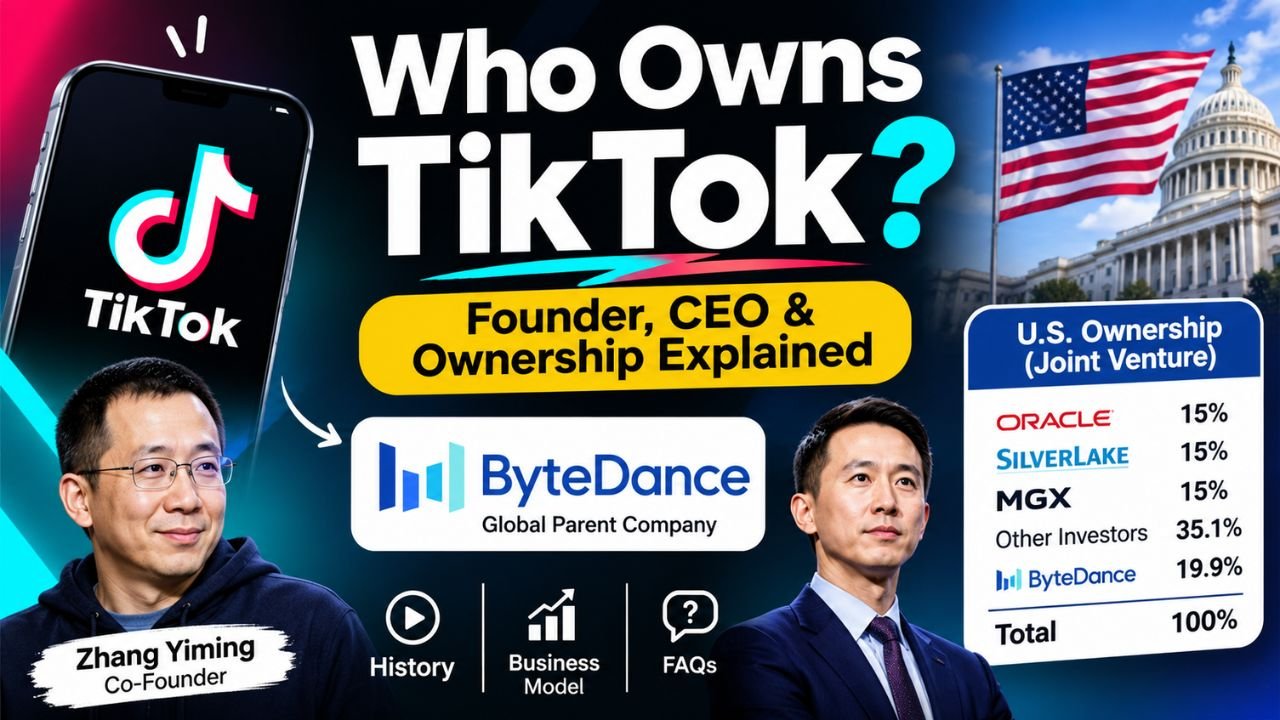
Who Owns TikTok in? TikTok is one of the world’s most popular social media platforms, known for short videos, viral trends, entertainment, and creative content. Millions of people use the application daily to watch videos, share content, promote businesses, and connect with audiences. But have you ever wondered who owns TikTok and which company operates this popular platform?
TikTok is globally owned by ByteDance Ltd., a technology company founded in China in 2012. ByteDance was co-founded by Zhang Yiming and Liang Rubo. However, TikTok’s US operations have a separate ownership structure following the establishment of a joint venture in January 2026. Let’s explore TikTok’s owner, founder, CEO, parent company, history, and business model.
Who Owns TikTok?
TikTok is owned globally by ByteDance Ltd., its parent company. ByteDance is a privately held technology company that operates several digital products and services across different markets.
The company developed TikTok for international audiences after launching Douyin, a short-video application designed for the Chinese market. Although both platforms have similar features, they operate as separate applications.
Here are some important facts about TikTok:
| Detail | Information |
| Platform name | TikTok |
| Parent company | ByteDance Ltd. |
| Co-founders | Zhang Yiming and Liang Rubo |
| Global CEO | Shou Zi Chew |
| Launch year | 2017 |
| Parent company founded | 2012 |
| Industry | Social media and technology |
| Main service | Short-form video sharing |
| US joint venture | TikTok USDS Joint Venture LLC |
ByteDance remains TikTok’s global parent company, while its US operations operate under a separate joint venture structure.
What Is ByteDance?
ByteDance Ltd. is a technology company founded in Beijing, China, in 2012. It develops internet platforms, content services, and applications powered by artificial intelligence and recommendation technology.
ByteDance became widely recognised through its content recommendation products. Its platforms use technology to understand user interests and recommend relevant content.
Some well-known products associated with ByteDance include:
- TikTok: A short-form video-sharing platform for international markets.
- Douyin: A short-video application designed for the Chinese market.
- CapCut: A video editing application used by content creators.
- Toutiao: A news and information content platform.
ByteDance has expanded its business internationally and operates products across different markets. Its ownership includes institutional investors, employees, and its founders.
It is important to understand that ByteDance and TikTok are not the same company. ByteDance is the parent company, while TikTok is one of its major social media platforms.
Who Founded TikTok?
TikTok’s international development is closely connected to ByteDance and its short-video application strategy.
ByteDance was co-founded by Zhang Yiming and Liang Rubo in 2012. Zhang Yiming played an important role in establishing the company and developing its technology-focused business model.
In September 2016, ByteDance launched Douyin in China. The company introduced TikTok internationally in 2017, bringing its short-video concept to audiences outside China.
ByteDance later acquired Musical.ly in 2017. In August 2018, Musical.ly was integrated into TikTok, helping the platform expand its international user base.
Today, TikTok is recognised for its short videos, music, entertainment, educational content, and personalised recommendation system.
Who Is the CEO of TikTok?
Shou Zi Chew is the CEO of TikTok’s global business. He is a Singaporean business executive who became widely known after joining the company as its chief executive in 2021.
Before joining TikTok, Chew worked in the technology and investment industries. He also held senior positions at Xiaomi, where he served as chief financial officer and president of international business.
As TikTok CEO, his responsibilities include leading the platform’s global business strategy, operations, and growth.
It is important to distinguish between TikTok’s global CEO and the CEO of its US joint venture. Adam Presser was appointed CEO of TikTok USDS Joint Venture LLC in January 2026.
Is TikTok Owned by China?
TikTok’s connection with China is one of the most frequently discussed topics about the platform.
The answer requires understanding the difference between a company’s country of origin, its shareholders, and government ownership.
ByteDance was founded in China by Chinese entrepreneurs. However, that does not automatically mean that the Chinese government owns the company.
According to ByteDance’s previously disclosed ownership structure, approximately 60% of the company was beneficially owned by global institutional investors, around 20% by employees, and around 20% by its founder.
TikTok has also faced regulatory scrutiny in several countries because of concerns about user data, cybersecurity, and national security.
Therefore, it is more accurate to say that TikTok’s parent company originated in China rather than simply describing TikTok as a Chinese government-owned company.
Who Owns TikTok in the USA?
TikTok’s US ownership structure changed significantly in January 2026.
On January 23, 2026, TikTok announced the establishment of TikTok USDS Joint Venture LLC. The new entity was created to operate under US regulatory requirements and protect American user data, software, algorithms, and content moderation systems.
The joint venture has the following ownership structure:
| Investor | Ownership |
| Oracle | 15% |
| Silver Lake | 15% |
| MGX | 15% |
| Other investors | 35.10% |
| ByteDance | 19.90% |
| Total | 100% |
Oracle, Silver Lake, and MGX are the three managing investors, each holding a 15% stake.
The remaining 35.1% belongs to other investors in the consortium. ByteDance retains a 19.9% ownership stake.
The joint venture has a seven-member board of directors and is responsible for US user data protection, cybersecurity, content moderation, and security of the recommendation algorithm.
However, TikTok’s global business and certain commercial activities, including advertising, marketing, and e-commerce, continue to have connections with TikTok’s other business entities.
This means TikTok’s US operations have a different ownership and governance structure from its international business.
How Does TikTok Make Money?
TikTok generates revenue through different business activities. Although users can download and watch videos for free, the company earns money from commercial services and advertising.
Its main revenue sources include:
1. Advertising: Businesses pay to display advertisements to TikTok users. These advertisements can appear in different formats across the application.
2. TikTok Shop: In supported markets, TikTok Shop allows businesses and creators to promote and sell products directly through the platform.
3. Brand Partnerships: Companies collaborate with content creators and influencers to promote their products and services.
4. Creator and Business Services: TikTok offers commercial tools and promotional features that help creators and businesses reach their target audiences.
Advertising is an important part of TikTok’s business model, helping the company generate revenue while providing free access to its main video-sharing service.
When Was TikTok Created?
TikTok’s history began with ByteDance’s development of short-video and content recommendation technology.
Here is a simple timeline of its development:
| Year | Major Event |
| 2012 | ByteDance was founded. |
| 2016 | Douyin launched in China. |
| 2017 | TikTok launched internationally. |
| 2017 | ByteDance acquired Musical.ly. |
| 2018 | Musical.ly merged into TikTok. |
| 2021 | Shou Zi Chew became TikTok CEO. |
| 2026 | TikTok USDS Joint Venture was established. |
The platform’s international expansion and integration with Musical.ly played important roles in making TikTok a globally recognised social media application.
Visit More: Shah Bano || Mouni Roy || Shraddha Kapoor || Neha Kakkar
Frequently Asked Questions About TikTok Ownership
1. Is TikTok owned by ByteDance?
Yes. ByteDance Ltd. is TikTok’s global parent company. It developed the platform for international audiences and continues to operate its global business.
2. Who is the owner of TikTok?
TikTok’s global parent company is ByteDance. The company was co-founded by Zhang Yiming and Liang Rubo in 2012.
3. Is TikTok owned by the US government?
No. The US government does not own TikTok. Its US operations are managed through a joint venture with private investors, including Oracle, Silver Lake, and MGX.
4. Who is the CEO of TikTok in 2026?
Shou Zi Chew is the CEO of TikTok’s global business. Adam Presser is the CEO of TikTok USDS Joint Venture LLC.
5. Who founded ByteDance?
Zhang Yiming and Liang Rubo co-founded ByteDance in 2012. The company later developed several popular digital platforms, including TikTok.
6. Does ByteDance still own TikTok in the USA?
ByteDance retains a 19.9% stake in TikTok USDS Joint Venture LLC. The remaining 80.1% is held by other investors.
7. Are TikTok and Douyin the same application?
No. TikTok and Douyin are separate applications developed by ByteDance. TikTok serves international markets, while Douyin is designed for users in China.
Conclusion
TikTok is globally owned by ByteDance Ltd., a technology company co-founded by Zhang Yiming and Liang Rubo in 2012. Shou Zi Chew leads TikTok’s global business as CEO. However, its US operations have a different ownership structure following the establishment of TikTok USDS Joint Venture LLC in January 2026.
Understanding these differences helps explain who owns TikTok, who controls its operations, and how the platform operates in different markets.
